All Over The Road
Slowly but surely I am creating my web presence. I imagine it will take a lot of discipline to keep any blog up to date. And it probably takes a big ego to think that you have a something interesting to say every day. Well, let's hope I can find enough to keep talking - although talking to oneself is talent worth developing.
Click on the player below to listen to my selection of tunes from International Artists Company website while you browse - and support independent artists!!


Station at KIAC and IACmusic.com

Monday, May 02, 2011

Vespas in Arezzo

Piazza Grande; from left - S. Maria della Piev...

Image via Wikipedia


I went back to Arezzo (in Tuscany) this weekend. I lived there for a couple of years during the 90’s. It was good to see my old apartment (Casa dello Capitano) in the “centro storico” and to wander the streets I knew so well. While there I picked up a CD by an old friend who lives in the area. He formed a band called Casa Del Vento.   It's a bit unusual to find, in the middle of Tuscany, a group of Italians who play using traditional Irish instruments.


Being the first weekend of the month, it was also time for the Feria Antiquaria. As usual, the streets were thronged with bargain hunters and there were lots of very interesting articles on sale. There was also a disturbing amount of Nazi paraphernalia mixed in with the genuine antiques on sale.

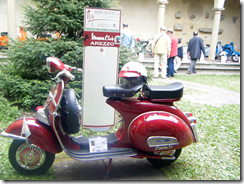
However, there was a bright light of culture which obscured the bad taste left in my mouth – and that was an exhibition by the Vespa Club of Arezzo. image


They had a couple dozen models of classic Vespas on display dating back over 60 years. I would have loved to stay on till Sunday to join them for their “rideout”. Had a little chat with the organisers and explained that I used to live in Arezzo and that I would have loved it if I had my own Vespa there to take on the rideout but, as my PX 200 is only 11 years old, I think it might have felt a little out of place.


imageimage

imageimage                                                                                 image

Unfortunately, the battery in my camera was dying but I managed to get a couple of pics before it gave up the ghost.

Enhanced by Zemanta

Friday, April 22, 2011

The future of the music industry?

Image via WikipediLady GaGa concerta


If you want to listen to unsigned artists, you can try www.iacmusic.com and www.mymajorcompany.co.uk. You won't get the latest noise by Lady Gaga but you can find some incredible music by musicians you might never hear otherwise.

IAC allows you to create radio stations and add songs to it from the artists on the site. You can share your thoughts about the tunes with the artists and they often respond. You can also purchase tracks for download and I love the fact that every single penny you pay goes directly to the artist. There are thousands of artists and many different genres to choose from. You are bound to find something you like.

Image representing My Major Company as depicte...

Image via CrunchBase

My Major Company also allows you to listen to new artists for free but, here's the twist, you can also invest in them. You buy £10 shares in an artist's project up to a maximum of 100 shares. When an artist raises £100,000 in shares, they are signed up and release an album. Then a percentage of all the profits made are shared amongst the shareholders - physical and digital sales, merchandising, live apprearance fees, and other ancillary rights. I have bought a share in a new band called "Millers Daughter". They are twin girls from Stonehenge who look and sound great. Could be a mini-Corrs! They have already raised £31,000 towards the target. Hope they get the whole amount soon. I think they could be a summer sensation if they can release in time.

It's a great way to get involved, hear free music and maybe make a few pence. Just think, you could own a piece of a future Beatles! In fact, if it's not someone stealing his identity, Paul McCartney is a shareholder of a band called "The Draytones". Not surprisingly, they have a bit of a Beatle-ish sound.

In the end, these sites provide an avenue for new artists to be heard and rewarded for their talent. Even in the age of digital downloads, it is still a music "industry" and the industry usually decides what we get to listen to. This is a way you can make the decisions yourself about what becomes popular, help an artist earn some money and maybe make a profit. It's a win-win situation.

Enhanced by Zemanta

Wednesday, April 06, 2011

Yay, for Windows Live Writer and Zemanta


I have been pretty useless as far as keeping up my blogging has been concerned recently – in fact, was never much good at it. However, I am now using Windows Live Writer The Windows Live Writer logo.and I have rediscovered the Zemanta browser add-on.
Images via Wikipedia and CrunchBase

Image representing Zemanta as depicted in Crun...


Zemanta’s is now available as a Live Writer plug in and is a great resources for finding links, posts and images that reflect the content of your post and they worry about the copyright.


For example, let’s say I mention Libya (en) Libya Location (he) מיקום לובin my blog, Zemanta suggests several images taken from Wikimedia Commons, Flickr and various stock photo providers related to Libya. It also provides the hyperlinks for Windows Live Writer, Zemanta and Libya in the copy above AND it provides links to some related articles if your readers want to follow up. 


Enhanced by Zemanta

Pay Per Post–continued

Ok, so I’ve set up my Pay Per Post account. Confirmed it by writing a random sentence in a blog post and …. no advertisers and what seems like a fairly p***sed off community of users. I’ll give it a while and see if things improve. Shame if they don’t ‘cos I thought it was a great idea. I had visions of reviewing ground-breaking software, services or products AND getting paid for my opinions. And I thought it might drive traffic to my site. Well, will just have to hope that first impressions aren’t true.

Tuesday, April 05, 2011

Pay Per Post

I've decided to look into the model of customer generated advertising. To this end, I have signed up to Pay Per Post. In the coming days and weeks, I will see if this compromises or complements my blog content. To activate the account, I need to prove that I own this blog. To prove that I must add the following random sentence somewhere in a post: A climate mangles a rush myth.
Let's see what types of advertisers I can choose to blog about. I'll let you know how it goes.

Recent online discoveries

This week, I've been lucky to find a great new site. Ok, so the French site is not new but the UK one is.
It's called My Major Company.
I've always been keen to discover new music outside the traditional A&R trash that's shoved down the public's throats on MTV and the radio waves. The IAC (Independent Artists Company) player at the top of my blog is testament to that. I love the fact that the artists get to keep every single penny when punters buy their music for download from the site. And I love the fact that I get to hear new music that might never get heard otherwise. Artists can get together and collaborate. They get feedback from the public directly and can talk directly to their fans.

My Major Company, however, is more like a traditional record company. The big difference is that the public are invited to invest in new artists. Shares are on sale for £10 each and you can buy up to 100 shares in any artists you choose. Once the artist raises £100,000 in shares, they are invited to make a record. Shareholders then can earn a return on their investment if the band is successful. I love this business model even more than IAC. Not only do I get to hear up-and-coming artists who might never get heard. I get to express my opinions AND I may even make a small profit (or a large one if I invest in the next U2).

I bought one share in a band called Millers Daughter and have high hopes for them. Not only are they talented musicians, they are also gorgeous blonde twins!!!! Here's hoping they can turn my £10 into a £1 million so I can retire. As of today, they've raised £31,180 towards their first record. I'm sure they'll go all the way.
I'll keep you posted.

Sunday, November 28, 2010

Localisation and your business

In my career field, Localisation, I think there is a lot of scope for expanding a service offering to smaller businesses.

localisation - (l10n) Adapting a product to meet the language, cultural and other requirements of a specific target market "locale".
The abbreviation l10n means "L - 10 letters - N".

(definition taken from the free dictionary)

At present, only larger companies consider Localising their products. However, I think that, in these challenging economic times, it is the smaller businesses which could see the greater ROI. What Localisation can offer to a smaller business is a way of opening up new markets by making their product accessible to speakers of other languages. This can be by introducing your product to new international markets OR by tapping into the hidden markets in their own locale.

For example, in the UK there are many small Asian and Polish shops and businesses. These thrive on the older immigrant population who haven’t learnt English very well or prefer to deal in their native language. This market is untapped by English businesses simply  because they don’t advertise or communicate in any language other than English. Translating your menu, price list, flyers, invoicing and shop signs can draw in a whole new group of customers. For more bespoke businesses, you could consider adding face-to-face or telephone interpreting to your service offering. Yes, there are expenses in these things but they may not be as prohibitive as you think.

Translations typically cost around 10 pence per word. This means your 1,000 work menu would cost no more than £100 per language to translate. However, there are ways to reduce these cost significantly! You only pay full price for a translation once. If you an reuse a translation or parts of it, then you can see huge savings. There is a Review rate which translators charge which is a tiny fraction of what you would pay for a translation. This Review is to ensure that the translation you are reusing still carries the same meaning if you are using it in a different “context”. I’m sure you’ve seen some strange results if you try to use an online translation tool. This is because the computer does not have a way to understand the context of how you are using the language. Think, for example the confusion that could be caused by the different context when using the word “bum”!  A mistranslation of this word could lead to embarrassment or the alienation of potential clients. There are also cultural sensitivities which need to be taken into account.  A Localisation professional can show you techniques to keep those costs low by carefully considering how you compose the English text to be translated. Let’s look at some examples of how to do this.

A Restaurant

There is no reason not to use the same English in your menu, flyers, online and newspaper advertising.  The names of dishes will always be the same but, if you also make sure that the descriptions used are also the same from item to item, then you don’t have to pay to retranslate every time.

Estate Agents

Property descriptions generally tend to utilise set phrases which are standard. When you are advertising a new property, try to use similar language patterns wherever possible. This reduces cost AND means you can have translations ready in a fraction of the time. Updating your flyers and website to be available in several languages at once can be done in a matter of minutes if correctly organised.

Also, consider using an interpreting service to help you communicate with the clients during viewings and negotiations. This can be done face-to-face or over the phone and the cost can be quite reasonable.

Retailers

This is where Localisation really comes into it’s own for a smaller business; both in-store and online!!  POS signs, information sheets, flyers for distribution, mail shots and websites can all be quickly and cheaply produced in multiple languages. Customers can browse online in their own language. They can then shop online or come into the store having already researched their purchases. You can help to ensure repeat business by sending out mail shots in their language of preference.

These are just the tip of iceberg ! Use your imagination and see how your business can expand in these times of contracting markets by opening up your business offering to multiple markets rather than relying on the health of your traditional customer base. Make Localisation your best friend.

Tuesday, May 05, 2009

Pete Townshend lifts the lid on Quadrophenia - the musical

Thursday, April 30, 2009, 14:25

The Who’s seminal album Quadrophenia comes to life in a new theatrical production, largely based on the successful 1979 film. The new musical received its premiere at the Theatre Royal Plymouth from May 9-16. For all ticket details see www.theatreroyal.com

Here Who guitarist, Quadrophenia writer and former resident of Helford in Cornwall, Pete Townshend, talks to What’s On about the show.

How did you come to write Quadrophenia – what was the catalyst and also what came first the story or the songs?

I have a strange way of approaching what I do. I am inspired by very diverse circumstances and conditions. A new piece of computer software, something that simply makes funky drum sounds, might set me off. A walk by the river or looking at the sea might start me off on some tangent as a lyricist. I might position a table in a particular place in my home and find I write a whole batch of essays, poems and lyrics. A new guitar (or guitar open tuning) could inspire a burst of creative work. I am especially stimulated by the designing and creation of studio-workshops and technical workplaces. The modern recording studio is as much a hobby for me as a train-set or a boat. There is a lot childlike play in all this.

Click here for more

With Quadrophenia, a very wide range of these kinds of inspirational strands came together in a very short space of time. The Who as a band decided to build a commercial studio for themselves. I was already building a private studio for myself in the country. My studio at home in London was tiny; nevertheless a lot of the music for Quadrophenia was written there and the recording started there. I was also pursuing a new idea, telling a story using sound effects. So I was often out and about with a field recorder listening to trains, birds, cars, planes, rivers, the sea and the chatter of people in pubs.

In the midst of all this came the news that quadraphonic sound was about to arrive as a domestic format on vinyl records. Pink Floyd had already pioneered four-channel sound in their concerts, but what excited me was bringing The Who - an astonishing band to stand in the middle of when they played at full tilt - to life on vinyl in surround sound. So, the two new studios, one for The Who in Battersea, and one for me in the country, were designed as the first quadraphonic rooms in the world.

At the same time, I felt I wanted to try to compose a set of songs about the internal struggle I saw so many of my peers were still experiencing. A lot of them seemed to have drug and alcohol issues that had turned into psychoses. Remember that my immediate peers had all been mods, most of them, and so it was natural to set the story in the closing years of that movement. One or two of the songs were already in place: Drowned, Love Reign O’er Me, and Is It In My Head, were all songs about the desire for some spiritual sustenance in a world that seemed devoid of faith and direction at the time. The old wartime values were still invalid, remember. Using these three songs, I scribbled out the story you see inside the cover of the record sleeve and started to discuss it with my friend and mentor Richard Barnes, and the photographer-essayist Ethan Russell. From these discussions emerged the idea of a four-faceted character, coming at you from four speakers.

Subsequently the idea was somewhat deepened, but also somewhat confused, by the notion that a member of The Who could reflect each facet of Jimmy’s character. I am still uneasy about this. This is the story of a member of our audience not of the band, but we had big egos and wanted to feature in the story somewhere. The only song I intended to speak about the band was The Punk and the Godfather, which was actually highly critical of what we had done thus far.

On top of all this I could feel a new wave or reaction rebellion coming in the music business. The big bands were becoming careless and self-indulgent. I wanted my songs to continue to have a cathartic function for our audience. When punk hit a few years later I was not surprised.

The mod movement of the 1960s was almost forgotten at the time of the recording. Skinhead culture was springing up and was much more politically driven, albeit right wing. The mods I had known were all more gentle souls, effete in some ways, certainly intelligent and creative. What had happened to Jimmy? Where was he? What had he been through? Did he find what he was looking for?

This wide range of stimuli sets up a now familiar dilemma for me, in that when I look back I can tell the story of any particular project in a number of different ways. I often feel I am guilty of revisionism, and am sometimes accused of it. More on this later maybe.

Before it was adapted for film, Quadrophenia was a designed as a rock opera – is the stage where you had in fact always imagined the piece? Did you always have a performance in mind?

We had performed Tommy in its entirety many times and I felt Quadrophenia would blow it away in live performance. But we got sidetracked by the complications of the necessary technology. We were highly pressured by deadlines, so we didn’t perform the complete work until 1996. I wanted to have a quadraphonic PA system like Pink Floyd, but have a dramatic reason for using it. I wanted a great album and a great vehicle for our live shows. In the end only a few of the songs survived to be played regularly as part of The Who set.

What do you most fondly remember about developing Quadrophenia? There’s so much – the experimentation with sound, the exploration of the themes (via the story and the music) and the film to be proud of…

I loved all the technological innovation, there was a lot of fascinating research involved. The film was different because it happened in the final years of punk. We actually tried to cast Johnny Rotten as Jimmy at one point and he and I became friends. I didn’t have much to do with the film. John Entwistle was music director and I concentrated on providing one or two pieces of incidental music that was required. I was personally on a big drinking jag when the film was made. To achieve what I’d managed to achieve as a writer and performer in the years from 1964 to 1976 required full-time work from me. When the other band members were resting between tours, I was working, writing, or researching; I didn’t get a break. By 1979 when the film was made, shortly after Keith Moon’s death, I had taken on a solo record deal as well. I had been much encouraged by my managers and advisors who thought it would help me feel more fulfilled. In fact it was the last straw. So the film passed me by in a bit of a haze, but when I came round from my stupor I was deeply impressed.

How did you feel watching it for the first time? Did director Franc Roddam et al interpret the story in line with your vision?

I didn’t feel the script went deep enough into Jimmy’s psychosis and I was sad that it didn’t precisely follow the song-cycle structure. However, I also knew that there was no story in place on the album, just a journey that was deliberately left vague and open so that people listening could get inside it. The film needed a story, and Franc and his writer came up with one. I was delighted with the film when I saw it, truly, but I didn’t feel it was my work at all. The response to the film from the public was good – and within a month the mod movement seemed to have enjoyed a revival.

Why do you think that the subject matter of the film (and indeed the album) is so lastingly popular?

The mod period was a very special one.

This story is set in the 1960s at a time where society is still struggling after a recent war, as its liberated youth reasserts itself. Historically, the conflicts on the beaches are remembered, but only because they fit the language understood by the older generation of that time and its tabloid press. They were a small part of the mod happening. In fact, the assertion of new values by the mods was different and simpler to the one espoused in a more conventional story like West Side Story.

While to an observer it was clear Mod kids wanted to be a part of something, it was also clear that the choices they made as a group were rebellious as seen by the old order. The mod girls looked like boys, the mod boys were soft and didn't mind looking fey, dancing alone, wearing eyeliner.

Meanwhile, what the older generation missed was the enormous inner struggle many of the mods were going through. Repudiation of the old ideals of the war years meant that even conventional methods of courting were defunct. Certainly the notion of ‘uniforms’ within the mod movement was absurd because the charismatic individuals - the so-called Faces - were always trying to change their influential look over a single weekend and thus restore some sense of their very temporary leadership and individuality.

Suddenly, around the time of the mods, young people were aware of individual responsibility, especially for their own emotional safety and sense of security, and for their sense of belonging. There were terrible cases of conflict where children and their parents really could not understand each other at all – this is echoed today: a black mother is writing about black gang culture using her son's stories as her research base. However, the mod years also repudiated that the issue of ethnicity was important. There weren't many black mods, but the ones there were had real influence. In the parallel black community of the times, the Blue-Beat movement, the fashions often overlapped under and over those of the mod groups.

Today, all these issues seem to be relevant and significant again, but with new shades of course.

How will Quadrophenia be staged for this production? What can audiences expect from this adaptation? Will it resemble the film?

We are hoping for a new kind of musical. That is probably dangerous, but that is what we want. It will not resemble the film, except that I believe the girl will be more important in this play than she was on the album and more pivotal than in the film. On the album we only observed the girl from Jimmy’s screwed-up point of view. In the film, and more so in our play, we see her as real person, with her own story to tell and her own frustrations about what mods did and did not achieve.

What do you hope the stage version will achieve?

I want the show to entertain, of course, but a grander mission is to see it connect with the audience as well. Good rock music, as we now call my kind of pop, must be functional, it has to do something more than just entertain.

To what extent are you involved in this staging?

I am the old bloke who talks too much and falls in love with every single member of the cast, male and female. I am involved, of course, but I am trying to keep out of the way. This is a fresh interpretation of the music and, having already fallen in love with the new cast, I am certain they will bring new life and new angles to the story.

How has this stage adaptation come about? Did you take much convincing to get involved?

I took a lot of convincing. Not because I felt Tom Critchley and Jeff Young were on the wrong track, but because of divided loyalties. The Who do a terrific live performance of Quadrophenia, with video screens helping to tell the story, and Roger is very keen, and has been for the past three years, to tour The Who’s concert version one last time while he can still sing it (it’s hard to sing well).

Roger put a lot into the stage version we did, and it was great for me to be able to work with him creatively for the first time with such trust. So it took a big leap of faith for me to say no to my beloved mate Roger in The Who and yes to the huge ménage of reprobates who are now putting up the show at the Plymouth Theatre Royal. I think in the end my aspirations as a composer and writer for the theatre proved more powerful than my desire to play this wonderful music on stage with The Who. The Who version may happen again, but not for some years now.

Are you enjoying this process and revisiting the material? And do you ever revisit the film?

I sat in the casting sessions quietly, somewhat stunned at how wonderful it all was. To hear my songs sung by new young people is a thrill. I enjoy working in music theatre and have a huge amount of experience now. I feel at ease, and a part of the team. It is humbling and exciting at the same time. The film is not something I see as a part of my personal creative thesis, but there is a sequel being developed at the moment within The Who managerial camp. I am not a part of that process either and I doubt there will be any new music from me.

One thing is certain, in my original book Jimmy did not die at the end of the story, but I have no idea what happened to him. Any sequel will have to make a huge and arrogant leap to decide what happens to him and I hope it doesn’t spoil our individual fantasies about what Jimmy might have done when he got off that rock in the rain.

How do you think new audiences – those who have yet to discover the film – and existing fans will respond to this adaptation?

I have no idea. But the young cast members all said they felt a connection with the issues it embraces. But then they would, wouldn’t they? My concern is that mod old-timers might get too caught up in what they believe to be the fine details. We are not trying to recreate the mod world. In fact, a lot of modern mods get it badly wrong.

Mods rarely wore parkas except when on a scooter – that’s just an example. Today young people show up at Who concerts wearing parkas. That’s fine for today, and we need to let the past go. What I want new and existing fans to do is respond to the story as it told today and to try to find something in the show that enriches their lives today. I also hope they have a great time.

Have you/the creative team reworked any of the music for the stage? If so, what can audiences expect? Are there going to be any new songs, for example?

There are some old Who songs included from the early years in a club scene, but otherwise no new music. I will help audition and choose band members, and guide their playing.

Can you describe how important this album and the film are to you? You’ve said in the past that Quadrophenia was the best and will the best you have ever written. Do these feelings still stand? How does it figure in your list of creative achievements?

Tommy is my most successful and visible song-cycle to make the jump to film and music theatre. But Quadrophenia is the composition I am most excited about, partly because it is so tricky to stage. It does not have a straightforward story. Some of the best dramaturgs (directors and artistic directors) have had trouble finding a way to make it work and stay faithful to the music. If we can make this work, it will bring me real satisfaction, but also make me feel that my commitment to the pop and rock form, and the rules they are bound by, can work at many emotional levels.

Jimmy’s story – especially after his epiphany where he finds clarity and redemption – is incredibly inspiring and thought-provoking? Do fans and audiences often admit to you how it has influenced them?

Fans are always telling me that Quadrophenia either changed their life or helped them in some way. I’m not sure Jimmy does find clarity or redemption. What is clear, is that he yearns for it. I think that yearning for meaning is what people relate to.

In your short story in the cover notes you wrote: The guitar player … He wrote some good songs about mods but he didn’t quite look like one.” Forgive me if I’ve misjudged this, but it certainly suggests you were not one. What were you feelings towards the mods?

I was a mod. No question about it. The other three guys in The Who were not. My best friend at art college Nick Bartlett and his older brother Tim were the sharpest mods I came across, I hung out with them as much as I could. The thing is that anyone could be a mod. You didn’t need to be working class. I once hung out with a group of mods in Brighton with a girl, and we slept under the pier and chased rockers. The rest of the band had gone home. I wanted to feel a part of something, I always have. The mods allowed me that. When I went our clubbing in Soho, dancing I came across some of the Faces of the day. Phil the Greek, Julie Driscoll, Rod Stewart, David Bowie, Marc Bolan, Micky Tenner, Sandie Sargent and, of course, the Small Faces themselves. I was always close to the greatest Face of them all, Peter Meaden, and if The Who hadn’t got in the way I would have embraced the mod movement far more deeply. But my position on the stage allowed me a good view of what was going on. I became someone who gave a voice to some of those mods. But I was a part of what was happening. When LSD hit London I moved on, like so many others.

You’re known for your music and writing, are you a fan of theatre? What musicals, shows or theatre professionals are you a fan of?

I like Tom Stoppard’s work, especially his Arcadia, and Kenneth Brannagh’s work on Shakespeare, especially his film of Hamlet. I am a huge fan of Arthur Miller and was an investor on Last Yankee back in 1993. Musicals? I liked Cats and Phantom of the Opera. I love the soundtrack of the Phantom of the Opera movie, and I adore Minnie Driver as the Diva. I liked Rent, and Guys and Dolls at the National years ago. I’ve seen ‘em all. I think my favourite musical is Into The Woods by [Stephen] Sondheim and Lapine. I also like West Side Story as a film – who doesn’t. I am a huge Abba fan, so I am looking forward to watching Mamma Mia when I have time. (Ken Russell said I would love it).

Have you had any feedback from Roger Daltrey? What are his feelings on the project? Will he be going along to see it? And will you be coming to see the production?

I will be there, of course. Roger will find this production tough to engage. He felt he should have been involved, and he might well be correct. I’m certain that given the chance his process, his version if you like, would have been a valid one. But I wanted to keep this production away from The Who and its internal machine. I hope he comes to see the show, and if he does I hope he likes what he sees. He wasn’t a great fan of the Broadway Tommy. Whatever he thinks he will tell me honestly and we will remain friends.

What else are you working on at the moment?

Oh God! This year is my year dedicated to writing. I have started so many things that I am excited about and I need to pick one to complete. I am composing a lot of new music at the moment. A lot of it sounds like old-fashioned music theatre stuff rather than pop or rock, so I have no idea where it will go. I am having a ball. I began this set of replies to your questions by speaking about how I respond to all kinds of diverse stimuli. This does tend to make my output seem lacking in direction, or overly eclectic. But as I close in on a final idea I tend to drop everything else and get very highly focused. At the moment I am working on about five or six ideas, in about the same number of different methods. I don’t want to say too much, in case I set myself up, but I having the most fun I’ve ever had in my life. My partner Rachel Fuller is working on three theatre musicals too, all at the same time - she is a composer – so the house we share is like a music workshop. It’s a great way for a musician to live. I am very happy about it.

The Who are touring Australia and New Zealand this spring, are there any more dates in the pipeline?

Ah! Now we hit the tricky part. I’m really happy to be going to Australia and NZ, but performing is not something I enjoy the way everyone around me does, and I don’t get from it what I probably should. I don’t like touring or performing, never have really. But I am very good at it, and I find it easy.

But I do get a lot of fulfillment from playing these days; I enjoy playing the electric guitar with our present band. I discover new things all the time. The best thing about the next tour is that we will be playing to new audiences. The other good part is that I love the guys in the band, their women, and our amazing crew. It’s a circus family of the best possible kind. The rest of the year I am writing, working on Quadrophenia, and I have no other plans. The Who get lots of offers at the moment, and many of them are very attractive and exciting. But I need to write, and these days it takes me a long time to do what I have to do.

Can you describe what it feels like performing live with the band again? Are you enjoying the experience?

I feel rather old all of a sudden, to be honest. I am very fit, but the aches and pains don’t go away after a tour the way they used to. I am definitely slowing down. That said, I will never make the mistake I did in 1981 when I declared I was leaving The Who. I sincerely thought the band would carry on without me. Roger simply wants me never to say “never”. I can live with that.

Tuesday, April 21, 2009

Pete Townshend on Quadrophenia, touring with The Who and the Mod revival

From
April 20, 2009


The presiding genius of The Who explains why, after 36 years, he is putting his masterpiece Quadrophenia on to the musical stage

undefined

It's 36 years since Pete Townshend wrote his rock opus Quadrophenia, later turned into a cult film, but he'd be the first to admit that nothing he's done since has equalled it. Now, as he and Roger Daltrey keep the 'Orrible 'Oo going part-time, Quadrophenia is back - this time as a full-scale UK touring theatre production, with Townshend a creative consultant. Are its tales of style-conscious Mods and teenage alienation in 1960s Brighton as much of their era as eel pies and popping “blues”? Or can this new version do what Tommy did in the early-1990s and make it all the way to new audiences on the West End and Broadway?

In a remarkably frank interview, Townshend discusses everything from Mod culture and musical theatre to his “Groundhog Day” life as a rock star and why he is “very afraid that the front row of the first performance will be Mods wearing parkas”.

Why do you consider Quadrophenia to be your masterpiece?

That feels like a midriff punch. The thing about being a writer who is also in a big rock band is that sometimes I speak with my bolshie rock star's attitude. At times like this, sitting now in Richmond quietly to try to talk about a piece of work I am very proud of, I recoil at some of the things I've said, or the way I said them in the past. But the ego-driven language does have a place: I have to accept that I probably don't have the energy, self-certainty or focus to produce something like Quadrophenia again. I not only wrote and recorded this record in 1973, I also built two quadraphonic recording studios, did a huge tour and many small shows here and there, helped Eric Clapton and his girlfriend Alice get off heroin, began to set up the Tommy movie contacts and wrote a number of songs ready for the next Who album, Who By Numbers.

In that sense my achievement was towering, and I am humbled by my work ethic when I was young. I needed to guide Quadrophenia alone. It was a new kind of song-cycle, a development on the system I'd invented for Tommy, and my previous attempt at a dramatic work, Lifehouse, had fallen almost at the first post. For a brief period I tried to work with our old producer and manager Kit Lambert because I was afraid of becoming overloaded. But he was in bad shape. The band, as with Tommy, fell in behind me in the most extraordinary way, although Roger had some problems with me having so much control, but that was only because there is no proper story, and the characters are so iconic and mythic. He wanted to find some way into the story, and I'm afraid I wasn't very helpful because I was deliberately keeping everything open and vague.

Today Roger is one of the few dramaturgs [story analyst] who can really understand what Quadrophenia was intended to do for its audience. Where the word “masterpiece” is appropriate is probably in the method of my work. I am a studio nerd, and some of the new technology of the mid-1970s promised all kinds of easy ways to make big sounds. Instead, in the studio I used old-fashioned methods, big studio drum sounds, layered violins (that I played myself), John Entwistle's powerful brass choirs, banjos, backing voices, bells and, of course, sound effects. All that and electric guitars. It was a fabulous time for me, because I love working in studios, and recording music. I gathered all those strands in a way that seems to me today to be quite masterful. I couldn't do it now.

What debt does Quadrophenia owe to musical theatre?

In a way, rock itself owes much to music theatre, simply because the songs from that world began to lose meaning in the late 1950s. I'd grown up very close to that music because my father was in a dance band. There was an intimidating body of work written by some of the finest composers and lyricists of a 30-year period. And yet the songs didn't seem to mean much to me or my buddies when we began to grow into our skin. There had to be something new.

But the supporting structure of music theatre somehow began to show itself like a manifesting ghost in early British rock. The Beatles larked about like Arthur Askey in a panto; Ray Davies exalted the glamour of the working-class world; The Who wrote songs about growing up that with a few word changes could have been squeezed into My Fair Lady. Music theatre, and its bastard brother music hall, had created and inhabited most of the venues that early British pop bands used to play in. You simply couldn't get away from the idea that it might come back one day, and of course it has. The musicals of the late 1950s - especially those by Lionel Bart - did try to anticipate what rock soon arrived to do. But Lionel himself told me once that he was just two or three years too old to understand what had been coming - it reminds me today of my anticipation of punk in the early 1970s. I knew something needed to happen, and I knew it would be subversive, but I couldn't see how it would take shape.

I always felt, right from my very first song and the reaction to it from the kids in my neighbourhood, that in a pop song the function was different to the songs from music theatre. There was already a story being experienced, by the listener - the context was already established. Songs about fantasy and a romantic future didn't seem useful any more. A song had to fit into the world we were living in, and that was an immediate postwar world in which Britain and its youth had to face massive change. The cult of the individual happened partly because we found our own language, and that was very much enshrined in music.

I think the Mods transformed themselves into a kind of living music theatre project in the early 1960s. So when I revisited the scene in the mid-1970s, it was natural to create a song-cycle to bring it to life.

Has Quadrophenia simply become a historical document? Can it really appeal to teenage culture today?

What a document! Everything was turned on its head. Girls looked like boys, boys wore eyeliner and danced alone or in pairs like girls. Today we are facing something of the same kind of upheaval. In the financial mess we are in how will young people express their need to be different? Roger Daltrey often says that Mod wouldn't have happened if well-paid work hadn't been available. But what awful work it was, and what antiquated rules and authoritarian systems were still in place. This musical version is inhabited by young people, and a few teenagers, but we are not trying to re-create Mod. It seems to happen every now and then as a throwback; I understand there is a big Mod revival in Southend at the moment and it will take off this summer.

What has been your involvement with the new production?

I have been involved until recently only as the original creator. After Tommy went to Broadway [in 1993] it was natural to look at Quadrophenia. I am now involved in the production of the show, the casting, the way the band works and will do some work during rehearsals. A lot of what I did on Tommy, after producing the script with Des McAnnuff the director, was deep background work with the cast. I tried to explain what it was like to grow up in Britain in the 1950s and 1960s.

Austin Powers has done a lot of damage to the image of swinging London, parodying what had already been parodied by lazy American newsreels over the years. So in a sense my mission is to bring back some of the greyness, the bleakness of those years, and demonstrate to the cast that what happened simply had to happen, otherwise we would all have gone nuts. It wasn't an optional outing of boys playing on scooters; it was a vital rebellion.

Where the Mod movement looks shallow today is in its lack of political, social or ecological interest. But you have to understand that after the ban-the-bomb movement and the failure of anti-apartheid, and then the Cuban missile crisis, young people felt their input was pointless. Fashion, music and daily life was elevated to a form of aloof poetry and was very much a secret society.

The production was slow to arrive because it doesn't have a conventional backbone. Unlike West Side Story, it is not based on a classic tale. In fact I avoided the temptation to complete the story or to try to make the characters whole and reachable. I have always understood that rock and pop need music and a star system that offers partly empty vessels to the audience. Quadrophenia isn't even about battles in the street, it's a musical journey inside a young man's mind during a drug-fuelled psychotic episode. But this is not a story about junkies. This is a day or two in the life of a young man who really can't do what his peers are doing and survive. Jimmy is an ordinary young man, with modest emotional needs, but who is looking for something other than what is on offer.

How has the experience with the musical theatre version of Tommy affected you?

Every manifestation of Tommy has had its price for me. Happily it has usually been lucrative as well. The music theatre version came late for me - I had tried to mount it in London in the late 1970s but it had clunked. There was always interest to try it again from New York, but I resisted. One day in 1991 I fell off a push bike, broke my wrist so badly that I was told I would never play guitar again, and possibly never be able even to hold a pencil. While I was still in plaster the offer to develop the Broadway production came in. I jumped at it, but said I would stay out of it, but was drawn in by my creative relationship with the director, Des McAnuff.

It was the most exciting and invigorating time of my life. The Who had been inoperative (at my behest) since 1982, and I got a taste of fame and glory again. I'm afraid it went to my head for a while. I quickly recovered when overwork led to me starting to drink again (after an 11-year break), but my marriage did not survive for very long after that.

In 1993 when Tommy went to Broadway I also staged Psychoderelict, my own solo musical, and later that year Iron Man at the Young Vic. So it was year of intense and varied music theatre experience. At the end of it I promised myself I would never take a careless dig at Andrew Lloyd Webber or Richard Stilgoe again. The creative work behind a musical is almost beyond imagination in scale - and the problem is that unlike normal theatre, the story changes as the music is played, with each singer, with each phase of performance. As the composer and/or lyricist you have to be on your toes until the day the show closes.

Have you ever been to see a rock musical based on a back-catalogue?

I live inside one. Musicals based on back-catalogues are becoming a saturated market. How can rock musicals avoid being watered-down exercises in asset-stripping?

Do you visit the theatre much as a punter? What plays have impressed you profoundly?

I don't go as often as I would if I lived in the West End, so I tend to do more theatre when I'm in New York, staying at a hotel right in the thick of the scene. It's great to walk to and from hotel, theatre and the restaurants involved in a night out.

I have been most profoundly affected in recent years by Arcadia and An Inspector Calls. In both cases the non-dialogue devices used at the end of the play - in Arcadia the return to the waltz, and in An Inspector Calls the collapse of the Victorian house - fold both plays entirely back into themselves in a manner that is almost musical. Certainly the device seemed familiar to me: the way that when you reprise a song at the end of a show it has new power, and brings everything that has gone before to life in a new way.

Musicals? My favourite of all time is Into the Woods. My favourite opera is Billy Budd. The last time I saw that (at Covent Garden) I realised I had stolen the entire setting of Billy Budd for my last scene in Quadrophenia, the young boy on a rock, alone, fearing death in the grey rain.

Back to Quadrophenia, the character of Jimmy is “not schizophrenic, he's quadrophenic”, the mixed-up, competing personalities in his head intended to represent four personalities of The Who's original members.

This is rather controversial, and I might be remembering it all in a distorted way. But what I recall was that it was not my intention that the personalities of each band member were meant to be part of Jimmy. Each band member was supposed to perform an aspect of each of Jimmy's four personality extremes. This is a crucial difference. Towards the end of recording, Roger lost patience with me. I had kept all the cards to my chest, and he wanted to see the release of a Who album not a Pete Townshend indulgence. He insisted the faces of each band member should be on the front cover and then it seemed necessary to alter the essay on the inside sleeve to reflect this change.

My view of a great rock band is that they merely hold up a mirror to their audience - even that analogy is too strong really. What we do is stand in front of a crowd, with their permission, and try to provide some cathartic function. For a lead singer such as Roger that is hard to accept sometimes - though he completely understands it. In fact he understands it better than anyone I know, but even so it's tough to stand on a stage and carry a show, but tell yourself you don't really matter.

Anyway, the device didn't work at all. What worked was Jimmy meeting an old schoolfriend who had happened to make it big (the Godfather) and having a pop at him for deserting his neighbourhood. The offering that the old friend he met was me, and I was in The Who, seemed to work OK. I think the notion that Jimmy had multiple personality disorder might have nearly worked as well. But it is the failure of this device that made it so hard in the past for conventional theatre people to trust that the show would work. It works musically I think, but is yet unproven dramatically. This is something we intend to fix.

With that in mind, does Quadrophenia summon up Keith Moon or John Entwistle when you hear it or think about it? And what's your experience when you listen to Quadrophenia today?

I remember those two men every day one way or another. Whenever I play Who music they appear like ghosts. In the casting sessions there was a moment when a large group of people were singing I've Had Enough - the song closes the first act - and I suddenly realised I had written the most wonderful music for a choir without knowing it. What choir would think of performing Quadrophenia? And yet it is ideal for the choral society in some ways.

What's your opinion of Frank Roddam's 1979 movie and the Mod revival that is spawned?

The Mod revival was already happening when we started the film. It is a good film, but I was sad it didn't follow the music. The problem the writer had is precisely the problem we have today - if you sing the music through, without changing too much, some of the characters are rather thin, and some of the events are lost in a druggy haze.

The film also set up some new issues: is the girl important? Today I think she is, whereas when I wrote the story I thought of her as an impossible idea in Jimmy's confused mind. Recently I've been able to put myself inside the young girl and ask myself if I would notice a curious boy like Jimmy, and imagine we might get married one day when he's settled down. The answer was that of course I would notice him.

The film also made the Ace Face real and tangible, and he too is someone who needs closer explication. Why does such a charismatic young man descend to the menial life of a job as Bell Boy? My conclusion today is that it works for him, it is an escape from the limelight, but also possibly a cover for his criminal activities. How else but from crime does such a young man afford such a great scooter and such smart clothes? Many of the leading faces in the Mod scene I knew were much older and mysterious figures who seemed to have more money than they should.

The film answered some questions and posed new ones. The most obvious question is whether Jimmy actually follows his scooter over Beachy Head. I have no idea.

How do you find relinquishing control of your work to the hands of others?

If I can really let it go, it is no problem. But I have been drawn into this production, and it is a problem for me. I am more an artist than a back-room man. I tend to grandiosity and absurdity, petulance and pride, when my work is challenged. That is a pity because I am a very good team player if I can keep my ego out of it. Luckily the creative team of Tom Critchley and Jeff Young on this project are people I've worked with before on Lifehouse Chronicles and Lifehouse for Radio 3.

Tom Critchley (the director) and I also enjoyed an association with Kneehigh Theatre for a while. The producer Ina Meibach, from New York, has been my legal and creative mentor since the beginning of my career in the USA in 1967.

Can you tell us anything about what you're currently working on?

Not really. I am writing, and for me that means I am waiting for something I am working on to land. I write essays, poems, lyrics, guitar tunes, piano pieces and bits of novels and autobiography every day. But if I told you what I was most hopeful about today I might set myself up to fail. I'm surprised how many projects I begin but do not finish. For me, art is finishing things. A pot ain't art until it's fired, even if it's a Bernard Leach. I have a lot of metaphorical wet clay in my life at the moment.

Do you need or have an audience in mind when you write? Who do you write for when you're creating new music now?

I am having to face that it is probably time for me to change. Whether I can change is another question. All my life I have tried to write music and lyrics that fit and deliver according to my notion of the function of rock and pop. For years this was a fairly straightforward brief, even if it wasn't always an easy one. The audience was usually young, evolving emotionally, feeling a little lost, fearful of sharing their fear. Now there is a huge body of guitar- driven pop that serves this audience, and, of course, I may have become too old to do it well, though the story in question never changes, not really. So I am looking at how I might change my target audience, and how I might use my experience so far in life to do useful creative work.

I have had quite a narrow experience, a repetitive Groundhog Day round of Who rock shows and PR, taking my kids to school every day for a while, then back to the business of being a rock star. All the time I've wanted to avoid turning into a wealthy baron who is out of touch with the ordinary world. Billy Bragg I am not, but I am close as it is possible to be for someone who has done what I've done; I admire and respect Billy Bragg.

Today I have to face that my audience may be too old themselves to change. I am very afraid that the front row of the first performance of Quadrophenia will be Mods wearing parkas. Even if they were young, it would be pretty awful. If they are in their sixties it could be worse. But what might be the worst of all could be fathers and sons coming together, wearing parkas. I have a nice dilemma. If I am to write for anyone, I want most to do something for that dad who is locked in the past, just as I sometimes feel I am. Quadrophenia should really shoot me into the present day. Maybe then I can write a song-cycle for a man on his deathbed.

Do you feel under pressure to tour with The Who and how hard is it to refuse?

I don't enjoy it very much, I'm sorry to say. I do get a lot of artistic fulfilment from it, especially as a performing guitar player, and I find it very easy. I am under pressure to tour with The Who. I can handle it, I think. If I really didn't want to do it I would just quit. After all, I quit in 1982 and didn't go back on stage with Roger and John again until 1996 when I did the first public performance of the complete Quadrophenia for the Prince's Trust at Hyde Park. The success of that event was what took us back to regular touring again. But I am quite capable of saying no.

My life as a writer is wrapped up in the Who name and brand - I can turn away from it, but in doing so I am only turning away from who I am.

I think what is important here is simply whether or not I'm always going to be capable of doing what it is I've always done so well on stage with The Who - which is to “catch fire”. I don't know what happens, but I walk on stage bored, catch fire for two hours and walk off stage bored again. I'm a peculiar piece of work.

Why do you now conduct interviews only by e-mail?

I stopped doing interviews of every kind back in 1997. I just felt I was repeating myself. I had done several hundred interviews for the various incarnations of Tommy from 1993 until the London West End production in 1997. I also found that the rock star arrogance I spoke of in the first answer has led me to say things that later I looked at and regretted. I start to stride around the room, my adrenaline flows, and before I know it I'm advising Mick Jagger to retire or picking a squabble with Kaiser Chiefs about when the riot they predicted is actually going to happen. I lose control.

Luckily some journalists allow me to do e-mail interviews. But many want to ask me the tough questions, watch my eyes, read my body, get a visceral sense of what is happening with me. I understand that, and perhaps one day I will go back to that kind of work with journalists because I miss face-to-face work terribly. Some of my most creative and vibrant moments have been in brainstorms with journalists.

I agreed to do some radio interviews, and some e-mail interviews when the Who's last album was released in 2006. But the first few face-to-face interviews immediately got me into trouble. In one I did with Rolling Stone, for example, I said I though Bob Dylan's work with the Band was corny. I said it, but it was not quite what I meant. I meant that Dylan suffered because he changed from folk to rock too late, and the Band had spent such a long time supporting the old then-vintage Canadian rocker Ronnie Hawkins for so long that Bob arrived as a rock artist sounding like an old timer already. The Band seemed to keep all their truly innovative tricks for themselves. That was a gaffe I regretted because I adore Bob Dylan and the Band. I sent letters of apology and Robbie Robertson replied saying, “I hope you're not losing your teeth!”

Most of all I love doing e-mail work because I can sit and properly consider what it is I really want to say over and above what it is I might be trying to plug at the time. I can also edit myself at least once before submission.

Is it any kind of reaction to the media ordeal you faced in 2003 (when he was investigated over the viewing of a child-porn website that he had once visited as research; he was never charged, nothing more illegal was found on any of his 14 computers)?

No. At that time I was advised by my legal team to keep my mouth shut, for the reasons I have stated above. But only because they knew me so well. I would have protested my essential innocence too much.[]

What's your opinion of social networking - do you use Twitter?

I published a novella using a blog over a period of several months, and the feedback seemed huge. But at the end, when I looked at the statistics, it became clear that quite a small group of people were on my blog almost every hour or two. So 500 people made themselves feel like 100,000. I'm not suggesting that the numbers matter in that context, it was a useful and encouraging experience, but it was salutary. I would not use Twitter. I do enough to annoy my old mate Janet Street-Porter as it is, and she now edits a powerful newspaper. She hates blogs and Twitter. As Benjamin Franklin said: “Never pick a fight with men who buy their ink in barrels.”

On the matter of people taking charge of their own communication, this is what I always thought would be wonderful about the internet when it finally arrived - that musicians and creative people in particular, could reach each other one to one. That is happening. The problem is transforming it from a series of small clubs into a commercial business equal to the one iTunes has parasitically imposed on top of it all. How do musicians make money? How do they experiment without being granted risk investment?

What's your view of free music internet stations such as Spotify and LastFM? Do you think they bode ill in terms of nurturing the next generation of start-up bands?

I have only just joined Spotify, and I haven't had a chance to listen yet. Starting a band these days is the same as it ever was. You start to play for fun, with ambition and dreams, live in fantasy and hope for a while. Then 99 per cent of us go back to our day jobs. I was a lucky one. Perhaps. That day job of yours often looks wonderful to me, but then I am human. We are never really content, are we?

What's next after the internet?

Compulsory electronic body implants linked to Gordon Brown's base station.

Quadrophenia opens at the Theatre Royal, Plymouth (01752 267222 ), on May 9, and tours until October (www.quadrophenia.co.uk )

Friday, March 27, 2009

The Who's Pete Townsend talks over life, love and new tour Endless Wire

The Who's Pete Townsend talks over life, love and new tour Endless Wire

Article from: The Daily Telegraph

By Kathy McCabe

March 27, 2009 12:00am

IN A frank a personal interview with The Daily Telegraph's Kathy McCabe, The Who's Pete Townsend talks about life, love and the love of music on the eve of the band's return to Australia.

Q: Your Australian promoter tells me your touring decisions these days are steered by potential enjoyment factor. Does that mean a good mix of indoor and outdoor shows, particularly if one of them is a winery?

Ah, I don’t drink alcohol any more, so I won’t be touching the wine. In this case we responded to the offer of this tour partly because it seemed exciting to come at the time of the Formula One racing, but also because we had planned to come to Australia when we did our world tour behind Endless Wire in 2006 and 2007.
That tour ended up being so exhausting that we needed a long break, and eventually had to face the fact that we had promised to come back, and we needed to make that promise good.
Without opening up a strange one-sided dialogue here, I don’t perform for enjoyment.
I certainly don’t tour for fun. I am almost unique in this.
I don’t really know any other musicians like me. I grew up backstage with my dad who played in a post-war dance band, so I always feel at home at a venue.
Backstage, I get sleepy, and want to curl up and snooze. I never get nervous, whatever the event. I feel quite detached until I walk on stage, and then some gear inside me clicks and off I go like a wind up doll.
As I move around, the adrenalin flows, and I start to get a little high. I often don’t smile, but if I do – and I sometimes laugh without reason – I’m afraid it’s because I suddenly feel the whole business of music for ‘entertainment’ is ridiculous.
But as soon as I come off stage I withdraw quickly, and go back to feeling sleepy. I hope we entertain, but we think we have a higher purpose too. I might say some more about that later.
In truth I probably put financial gain ahead of pleasure in selecting shows, tours and venues.
I still live off performing to some extent, though I obviously can live by my song-writing alone if I care to.
When I do a tour, I often buy myself a stupid car before I go on the road, so it is waiting when I get home like a reward.
Or I come home and spread the money around my family, staff, friends and charities. It’s not guilt about money, I feel that being paid to perform is right and just, but royalties from songs tend to feel like windfalls. So there can be abundance.
The really big tour from 2006-2007 was actually a poor earner as the dollar was so low when we finished. I also spent rather a lot on charter flights for me and me alone.
I knew it would be last time I could ever justify chartering private planes. I’ve stopped now forever. It’s not just about the pollution. I want to age with some dignity. I want to be part of the human race. So I get in line and take off my boots.

Q: What or who is driving the momentum for The Who to stay on the road during the past few years?

For a while I was perfectly happy not performing with The Who. From 1982 to 1989 I felt the Who did not exist. I let the band go, in my heart. However, Roger Daltrey had other ideas.
He would not let go. He worked on me constantly to go back out with him and John Entwistle, and when I finally did in 1996 with Quadrophenia I realised my long-frustrated dream to play that great work of mine in its entirety at last, with a narrative movie to explain the action.
We sort of drifted back into doing the rest of the Who material at the end of Quadrophenia, to create a friendly ambience for long-time fans.
This particular phase of Who work is still driven by the release of our last studio album Endless Wire. I’m not sure how many tracks from the album we will perform in Australia, but we are doing at least three songs.
At one time we were playing four or five, which is a lot of new songs for us. After the shows with you, I am settling down to try to write something new and different, or just something………my song-writing process feels very different today.
I don’t write for something we call “The Who”, with all its cumbersome history and theatrical stage songs. I just write music, or poems, or lyrics, or songs. If they work for Roger, or for me, we will record them.
I may never manage to write such a song again, but as Endless Wire featured some of the most recent and least anthemic songs I’ve ever written – just the songs that came to me as I stumbled through a novella I was writing called The boy who heard music – there’s a good chance we’ll find something when I’m done doing whatever I do in the summer of 2009.
John’s death in 2002 was also a factor in the return to serious touring. That 2002 tour was the last I ever intended to do with the band, and my mission was to make enough money for John so that he could get out of debt.
He had some back tax, and a double mortgage to juggle. He died the day before the tour was meant to begin. I felt his mischievous and wonderful sense of irony in that.
“You thought you’d give me handout Pete. Well now I’m giving YOU a handout. Take my share, and tour without me if you dare.”
It felt like a gracious gift from John, in the best of humour, even though his passing was really tragic. You’d have to have known him as we did to understand.
Roger and I were thrown together. We had been respectful, and friendly to each other, but we had never been great friends. We had never managed to find a way to live with how different we are, and how differently we think and work.
With John gone, we were on our own, no distractions, no excuses that we were working to help John pay his debts. We had to decide whether to go on, just the two of us, or take the opportunity to stop. Suddenly, I realised I wanted to go on.
I had always loved playing with John, but his passing would mean a new phase for me on stage, more space. John filled a lot of air with his huge sound and his extraordinary playing. Now I can be a real lead guitarist, and I’m learning fast.

Q: I was blown away by how powerful the band was on the last Australian tour. Is there alchemy at work in this line-up or graft ie dogged rehearsals?

The alchemy is there. It has new shades with the new line-up too. We don’t rehearse much at all. We often don’t always do sound-checks.
We save our energy and focus for those two hours and fifteen minutes on stage and don’t let up for a second.
Roger and I are old men. We’ve been doing this for years. We don’t need to practice; we need to catch fire and rise above the pain. I’m glad you liked our shows last time.
Pino Palladino played on Endless Wire, and is now starting to amaze even himself with his explosions of energetic creativity. It’s a really great band.
John Bundrick, on Hammond and keyboards, is a genius. Zak is getting better and better, and more musical every show we do. He says this is the hardest work he’s ever had to do, but we can’t keep him away.
My brother Simon is still with us, and is a joy to work with. He plays more and more guitar, and at first I found that tricky.
Now I am enjoying it, and we are finding interaction to be intriguing. He’s been a Who fan and guitar player since he was seven years old.

Q: Do you use soundchecks at all for working up new songs? Will there be another album?

I think I’ve covered this. But yes, if we do soundcheck we might work up a new song, or a variant to an existing song. But Roger and I both like to make stuff up on stage. The album? Why not? As I said, I just need to write and see what happens.

Q: Congratulations on the J.F. Kennedy Center Honours recognition. Are you a bashful award recipient? And what does this kind of recognition – and the recent Grammy nomination - mean to you now at this point in your life?

The other awards have mostly come quite late in my career, apart from the first proper gold album with Tommy. The Kennedy Center Honor meant a lot to me. To be so recognised in the USA, where our music had most of its roots, was quite a shock. What about Bruce Springsteen? The Rolling Stones?
Age seems to have something to do with it – most of the honourees over time have been in their sixties or seventies. Maybe Bruce is too young, but one day he will be honoured. As for the Stones, Keith Richards wouldn’t arrive on time, and so Mick would simply have had to refuse the honour. I’ll bet it has been discussed. Since we returned from Washington carrying our ribbons, I have had to fight the feeling that for me it spells an end, or a beginning.
I have even had to fight the feeling that it portends a surge. It was an amazing weekend of special events in which none of the recipients have to “sing for their supper” as the organisers like to say. We went to the White House, met President Bush and his wife Laura. I liked them both very much.
In the mode we met them they were like Hollywood stars – gracious, easy and extremely kind.
My best moment was when during the Gala performance the wonderful soul singer Bettye LaVette sang an astoundingly moving version of Love Reign O'er Me from Quadrophenia and Barbra Streisand who was sitting beside me turned to me in wonderment: ‘Did you write this beautiful song’.

Q: How emotional is the process for you when revisiting the archives for DVD releases? What do think of Pete Townshend The Younger?

Unless the great Barbra Streisand is gazing at me in awe I feel no emotion. This is my work. I have a function; it has been the same throughout my career.
When I see myself I don’t see an actor, or someone learning a craft, I see a young man providing what the rock audience who followed the Who expected from me. I came to expect it from myself.
I made music that was useful to my audience that in those days was mainly young men.
Now I have a 19 year old son. Sometimes when I see myself in film from the early days I am reminded of him, the body rather than the face (he is quite a bit more handsome).
I have always resisted the documentaries about the Who. I tried to stop Kids Are Alright.
I played no useful role in Amazing Journey. Yet these are the main vehicles for all of the amazing archive footage I so earnestly gathered over the years and protected in a special archive. Also – with Kit Lambert and Chris Stamp – I actually helped to make the films in many cases, or commissioned them. I nurtured friendships with filmmakers, and we let them into our private world on stage and backstage whenever we could.
Of course the fact that a lot of our filmed and televised interviews descended into insane humour at the insistence of Keith Moon adds value.

Q: In the history of rock, there seems to have only been two uniforms; T-shirt and jeans or the suit? Why are you generally more comfortable in the latter? Are they tailored or off the rack?

Ah! There was the boiler suit and Doc Martens for me for many years. After the psychedelic absurdities I decided to go anti-fashion. I first wore a suit on stage in 1989 for the band’s 25th anniversary tour.
Many of my friends thought I looked like a twat. I had a pony-tail, suggested by my beautiful and elegant wife, obviously in an attempt to keep the groupies away from me.
She was unsuccessful in her mission, and our marriage unravelled a few years later. I was quite handsome in 1989, though not as handsome as I am today.
I am currently wearing my Clash outfit on stage: very tight pants, black boots, black shirt and a kind of black surfer Volcom trilby with dark glasses.
I love to wear a suit sometimes, and I buy them off the peg from Prada, I’m a very ordinary shape. But when I wear a jacket I get fed up with the way it interferes with my arm-swing. The arm-swing has a limited life I fear, I am starting to sense my arm is about to leave its socket.

Q: Which collaboration did you find most revelatory during the Attic Jam sessions you did last year? How did you soothe the nerves of the younger contributors to the shows, I must say it would have been daunting for them to play in front of/with you.

The whole thing was a revelation. I started it purely to keep my fabulously supportive partner Rachel happy. She agreed to come on the road with me for two years, as long as she could continue to do her In The Attic show, which had been webcast once a week from a studio, and occasionally in Live shows at various venues.
We took it on the road in an Airstream caravan with a satellite dish. It was great for me, I was never bored at the prospect of just another Who show because I knew before the Who went on I would meet someone new on In The Attic, hear them play, talk to them, play with them, and possibly play something new or rare myself.
It became one of the most wonderful things I’ve ever done, but also quite tiring. I did have to go out of my way to make younger performers feel at ease, but even my contemporaries like Lou Reed, needed be welcomed and made comfortable.
I most enjoyed performing with Rachel. She is a genius musician. The last Attic Jam was a few months ago at the Troubador in LA. I remember every moment with every artist.
Every one was special, but it is the friendships I made from 2005 to 2008 on all the various incarnations of Rachel’s show that are most important – E from Eels, Billy Corgan, Sean Lennon, Martha Wainwright, Ben Harper, the Fratellis – and many more.
These are people I now feel close to. The really young ones like the Kooks, Editors, Amos Lee, Rachel Yamagata, Joe Purdy, Willy Mason, Mika, Adele – I have been blessed to meet them and join in their triumphs and struggles.
The music business has always been tough, but today there are some incredibly talented people like those I mention above who are fighting for attention and time, and working as hard as anyone from my early years. I felt the honour was all mine, and I’m not kidding.
There was a very, very cool young Australian musician who was one of Rachel’s first guests on her web-cast show prior to the tour. We played together. I will ask her for his name tomorrow and send it on. (Best Buy in the USA are releasing the highlights from the 2006/7 shows on DVD, release date is next spring.) (musician was Andrew Stockdale of Wolfmother)

Q: When you are performing now, does it occur to you that there is probably a huge contingent of the audience who are seeing you for the first time? On the Australian tour, this will certainly be true. Does that impact at all on how you approach the show?

Of course, and many of the crowd are also much younger than we are. We play the famous songs partly for that reason. But I like to play the famous ones because they are so easy for me – they sort of play themselves. I can weave in and out. I really love performing to a new audience.
I like to see whether the Who’s rock function works for new people.
And often it seems to work very well. We have always made music that has been aimed at providing a kind of cathartic channel for our audience rather than express some inner feelings of our own.
Even as a solo artist I have always tried to keep myself out of the way. I have been offended when critics have said I have indulged in sentimental autobiography or indulgent heart-searching in my song writing. A lot of the time I was writing about them! Yes, songs about critics.
In Tommy there was autobiography, but I only realised that years later when I tried to understand its enormous and unexpected success.
It has its roots in the difficulties of my rather typical post-war British childhood: parents trying to find themselves after a frightening and traumatic time, and their growing kids wondering how they would ever be able do anything to match their parent’s courage. New audiences hear Tommy, and find a different story, their own story: that is what matters to me.
I want the music to have function. If Abba’s music is to help us sing our way through a grey day, the Who’s music is probably better to stop you driving your car over a cliff. Both are important functions, but I always want to feel I have helped you see something about yourself, not something about me. Abba and the Who are closer than they might first appear. Love Reign O'er Me and SOS are both songs about the search for intangible love. Not a small subject.

Q: Have you ever seen anyone windmill better than you?

Nah!
Actually, I take that back. In 1982, soon after I left the Who for the long sabbatical I judged an air guitar competition for a London evening paper.
One of the competitors was a young woman wearing a mask. When she windmilled, certain other body parts came into play. Needless to say, she won. She married my friend Roger Taylor of Queen. Bloody drummers.

 
Creative Commons License
AOR (All Over the Road) by dublinjames is licensed under a Creative Commons Attribution 2.0 UK: England & Wales License.